No Personal Guarantee Business Loan: What It Really Costs


No personal guarantee business loans exist but are uncommon, conditional, and almost always more expensive than the headline suggests. If you qualify, you can protect your personal assets from a business default. The catch: lenders substitute other risk controls, and the cost of capital often runs significantly higher than a standard bank loan backed by your personal guarantee.

Three things to know before you go further. First, the trade-off is real: skipping a personal guarantee (PG) typically means paying a liquidity premium in the form of higher APRs, tighter covenants, or both. Second, lenders rarely walk away empty-handed; they replace the PG with UCC liens, collateral claims, or aggressive default triggers. Third, SBA loans are a hard exception. Under 13 CFR 120.160(a), every owner with 20% or more of the business must sign an unlimited, unconditional personal guarantee on SBA 7(a) and 504 loans. No workaround exists there.
Cotifunding is a business financing brokerage that connects small businesses with independent funding partners. It does not lend directly or guarantee approvals. If you want to compare no-PG options side by side without cold-calling a dozen lenders, that is exactly where a brokerage adds value.
Table of Contents
What a personal guarantee is and how it differs from collateral and a UCC lien
Financing types that can sometimes skip a personal guarantee
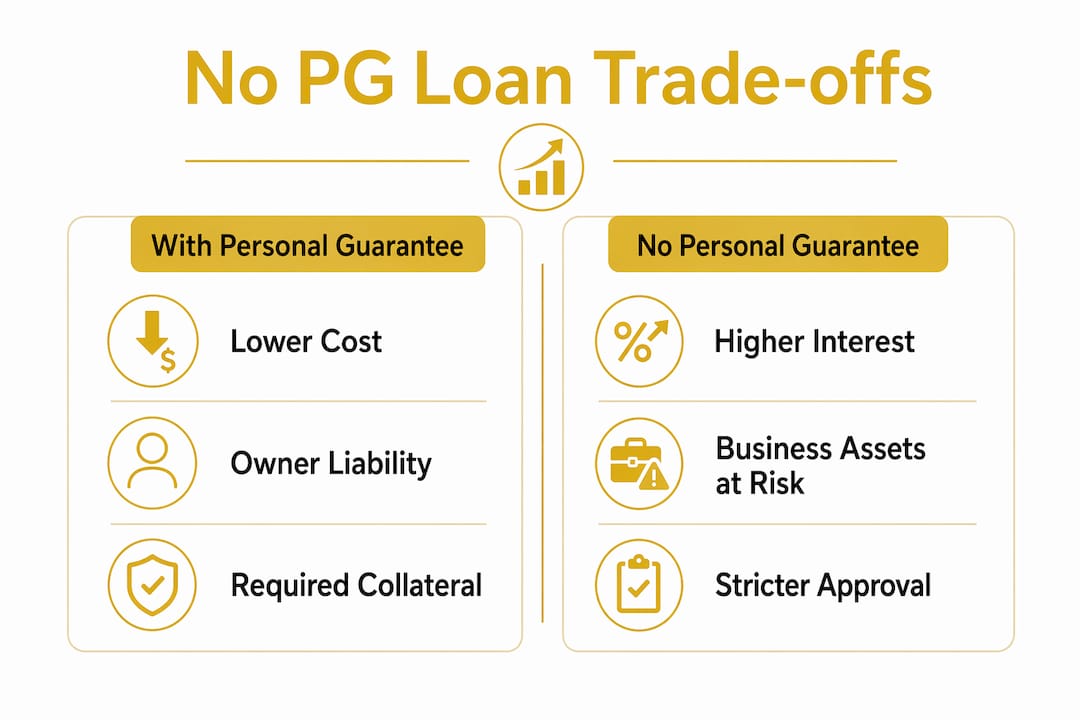
The trade-offs and hidden costs of skipping a personal guarantee
Who typically qualifies for no-PG financing and how to improve your chances
How lenders substitute risk when they skip a personal guarantee
What to expect when you apply: timeline and underwriting steps
Hypothetical cost examples: what the liquidity premium looks like in practice
Questions to ask lenders and red flags when they market “no personal guarantee”
Cotifunding helps you compare no-PG options without the guesswork
What a personal guarantee is and how it differs from collateral and a UCC lien
A personal guarantee is a written promise by a business owner to repay a business debt from personal assets if the business cannot. It makes the owner a co-signer in everything but name. If the business defaults, the lender can pursue the owner’s home, car, savings, and other personal property.

Collateral is different. When a lender takes collateral, it secures the loan against a specific business asset. If the business defaults, the lender repossesses that asset. The owner’s personal estate stays out of it, as long as no PG is attached.
A UCC-1 financing statement is a public filing under Article 9 of the Uniform Commercial Code. When a lender files a UCC-1 with the Secretary of State, it “perfects” its security interest, meaning other lenders can see the claim and the filing lender gets priority in a default or bankruptcy. A blanket lien covers “all assets of the debtor, now owned or hereafter acquired.” That is a sweeping claim, and it can block future financing even when no PG exists.
Contract language to watch for:
“Blanket lien” or “all assets” description in the security agreement
“Bad-boy” carve-outs that trigger personal liability after fraud, misuse of proceeds, or willful misconduct
“Carve-outs” on payoff that exclude certain assets from lien release
“Cross-default” clauses that treat a default on any other obligation as a default here
“Re-underwriting rights” that let the lender reduce access or freeze draws
Labeled example: A restaurant buys a commercial oven through equipment financing. The oven is the collateral. If the business defaults, the lender repossesses the oven. No PG means the owner’s personal bank account is not on the table. Compare that to an unsecured working capital loan where the lender demands a PG: a default could put the owner’s personal savings at risk.
Why lenders ask for personal guarantees
Lenders use personal guarantees to shift default risk to the owner when the business’s credit history, revenue, or collateral is too thin to cover the loan on its own. It is not punitive; it is underwriting logic.
When a lender evaluates a small business loan, it is assessing two questions: can the business repay, and what happens if it cannot? For an established company with strong cash flow and hard assets, the business itself answers both questions. For a younger or smaller business, the owner’s personal credit score, liquidity, and net worth fill the gap. A PG is the contractual mechanism that formalizes that backup.
Banks and SBA loan programs rely heavily on owner guarantees because their underwriting models are built around it. SBA SOP 50 10 requires an unlimited unconditional guarantee from every 20%+ owner on 7(a) and 504 loans. That rule is not negotiable. Alternative lenders sometimes market “no PG” products, but they compensate with higher rates, UCC liens, or both. The SBA’s own guidance notes that for newer businesses, loan eligibility is often still based on the owner’s personal credit score, even when a formal PG is not explicitly named in the contract.
Financing types that can sometimes skip a personal guarantee
These products can avoid a full PG only under clear conditions: strong independent business credit, sufficient collateral, or a product structure that shifts risk elsewhere. Startups and sole proprietors rarely qualify.
Corporate and fintech charge cards
Some fintech corporate card programs underwrite on business bank balances and revenue, skipping personal credit checks entirely. They require a formal entity (corporation or LLC), meaningful cash reserves, and demonstrable revenue. The credit limits tend to be lower than traditional lines, and the issuer still files a UCC lien on receivables in many cases.
Equipment financing and leasing
Equipment financing secures the debt with the asset itself. High-value, easily resaleable equipment (CNC machines, commercial vehicles, medical imaging devices) gives the lender a clear recovery path if the business defaults. That collateral quality is what allows some lenders to skip a PG. Younger businesses or those financing lower-resale equipment often still face a PG requirement.
Asset-based lending (ABL)
ABL lines are secured against accounts receivable, inventory, or both. The lender advances a percentage of eligible receivables or inventory value and holds a first-position UCC lien. Because the collateral is liquid and continuously monitored, some ABL lenders will forgo a PG for established companies with clean AR aging reports and consistent turnover.
Invoice factoring (non-recourse vs. recourse)
Non-recourse factoring exists, but it is less common than the marketing suggests. In a non-recourse structure, the factor absorbs the credit risk of the invoice debtor. The business owner is not on the hook if the customer does not pay, provided the non-payment is due to the customer’s insolvency. Many factoring agreements are actually recourse structures, and most still include guarantees around fraud or invoice disputes. Read the agreement carefully before assuming non-recourse means no personal exposure.
Revenue-based financing and merchant cash advances
Revenue-based financing (RBF) and merchant cash advances (MCAs) typically do not require personal guarantees because the lender takes a percentage of future revenue rather than a fixed repayment. The risk is priced into the rate. Effective APRs on these products frequently run significantly higher than traditional term loans, sometimes much higher for MCAs. The absence of a PG is real, but the cost of that absence is baked into every payment.
Non-recourse commercial real estate
Certain commercial real estate loans are structured as non-recourse, meaning the lender’s only remedy on default is the property itself. These deals typically require substantial equity (low loan-to-value ratios), strong property cash flow, and an established borrower. They are not a realistic option for most small businesses.
Trade credit and vendor terms
Suppliers often extend net-30 or net-60 terms without requiring a PG, especially once a business has established a payment history. This is not a loan in the traditional sense, but it is a form of no-PG business financing that builds the Dun & Bradstreet Paydex score simultaneously.
The trade-offs and hidden costs of skipping a personal guarantee
Avoiding a PG almost always comes at a measurable price. The lender has not reduced its risk; it has repriced it.
Common trade-offs:
Higher effective APR: The liquidity premium for no-PG products can be substantial. Analysts report that avoiding a PG can mean paying 4x–12x more in effective interest compared with traditional bank financing.
Lower credit limits or loan-to-value: Lenders cap exposure when they cannot pursue the owner personally.
Shorter terms: Faster repayment reduces the lender’s time-at-risk.
Stricter covenants: Minimum monthly revenue, cash balance floors, and reporting requirements are common.
More aggressive enforcement rights: Cash sweeps, holdbacks on card settlements, and freeze rights on deposit accounts replace the PG as the lender’s enforcement lever.
UCC blanket liens: A no-PG offer frequently comes with a blanket lien that restricts future financing.
Statistic callout: Analysts at NerdWallet note that borrowers often pay a hidden liquidity premium to avoid personal guarantees, with effective costs sometimes running multiple times higher than traditional bank financing.
The red flags are specific. A lender marketing “no PG” while filing a blanket UCC lien on all business assets has not removed your exposure; it has moved it from your personal balance sheet to your business’s entire asset base. Similarly, a “no PG” contract with a bad-boy carve-out can become a de facto personal guarantee the moment a covenant is breached or funds are misused. As Gerri Detweiler of Nav has noted, “no PG” is often a marketing lure; the comparison that matters is total cost of capital and the full enforcement package.
Who typically qualifies for no-PG financing and how to improve your chances
Lenders generally require two to five or more years in business, meaningful revenue (commonly $200K–$3M+ depending on the product), and independent business credit before they will consider removing an owner-level guarantee. Smaller or newer firms rarely meet this bar.
Eligibility checklist:
Entity type: Must be a corporation or LLC. Sole proprietors cannot separate personal and business credit, so lenders treat any debt as personal regardless of the contract language.
Time in business: Minimum two years for most no-PG products; five or more years for ABL and non-recourse CRE.
Business credit score: A Dun & Bradstreet Paydex score of 80 or higher (equivalent to paying on time or early) is a common threshold. Experian Business and Equifax Business scores matter too.
Annual revenue: At least $200K for RBF/MCA products; $500K–$1M+ for ABL and equipment financing without a PG.
Debt service coverage ratio (DSCR): Most lenders want 1.25x or better, meaning the business generates $1.25 in cash flow for every $1.00 of debt service.
Clean AR aging: For factoring and ABL, receivables should be current with no significant concentration risk (one customer representing more than 25%–30% of AR is a red flag).
No open tax liens or judgments: These almost always trigger a PG requirement or outright denial.
Documents to prepare:
Two to three years of business tax returns
Three to six months of business bank statements
Current AR aging report (for factoring or ABL)
Equipment invoices or appraisals (for equipment financing)
Entity formation documents (articles of incorporation, operating agreement)
Current UCC lien search results and any lien release letters
Steps to build eligibility over time:
Start by incorporating or forming an LLC if you have not already. Open dedicated business bank accounts and business credit cards. Establish trade lines with suppliers that report to D&B without requiring a PG. Pay the highest-dollar invoices first to maximize your Paydex score, since it is a weighted average. Add at least three to five trade references before applying for larger credit facilities. A business line of credit with a modest limit, paid on time, builds the credit profile that eventually makes no-PG options realistic.
How lenders substitute risk when they skip a personal guarantee
When a lender removes the PG, it does not absorb the risk. It reallocates it through liens, covenants, re-underwriting rights, and carve-outs.
UCC-1 blanket liens are the most common substitute. A blanket lien covers all current and future business assets. It shows up on business credit reports from Dun & Bradstreet, Experian, and Equifax. Active UCC filings can deter future lenders, reduce advance rates on new facilities, and block the business from pledging assets as collateral elsewhere. UCC-1 filings remain active for five years. If a lender fails to file a UCC-3 termination after payoff, the stale lien stays visible and can restrict access to new financing. Always request a UCC-3 termination in writing at closing as a condition of payoff.
“Bad-boy” carve-outs are clauses that convert a non-recourse or no-PG deal into personal liability under specific triggers: fraud, misrepresentation, misuse of loan proceeds, willful misconduct, or filing for bankruptcy in bad faith. These are standard in commercial real estate non-recourse loans and increasingly common in fintech products. A deal that looks like no personal exposure can become full personal liability overnight if the trigger is hit.
Enforcement mechanics that replace the PG include cash sweeps (the lender automatically pulls payments from the business’s deposit account), holdbacks on card settlement batches, reserve requirements that lock up a portion of cash, and freeze rights that cut off draw access on a line of credit after a covenant breach. These tools give the lender significant operational control over the business even without a PG.
What to expect when you apply: timeline and underwriting steps
Timeline ranges from a few business days for fintech RBF and corporate card products to four to eight or more weeks for asset-based lending and non-recourse commercial real estate deals.
Typical application steps:
Prequalification (soft pull): Most fintech and alternative lenders offer a soft credit pull that does not affect business or personal credit scores. This gives a preliminary range.
Full application: Entity documents, tax returns, bank statements, and AR aging reports submitted.
Document collection and verification: The lender verifies revenue, confirms entity standing, and runs a UCC lien search.
Underwriting: Credit analysis, DSCR calculation, collateral valuation. For equipment financing, an appraisal of the asset. For ABL, a field exam of receivables.
Valuation or appraisal: Required for real estate and high-value equipment. Adds one to three weeks.
Closing and UCC filing: The lender files the UCC-1 at or before closing. Funds disburse after all conditions are met.
Post-close, lenders on no-PG deals typically require monthly or quarterly financial reporting, minimum cash balance maintenance, and timely tax filings. Failure to deliver reports on time can trigger a covenant breach, which in some contracts activates a bad-boy carve-out or freeze rights. Staying on top of reporting is not optional.
Pro Tip: Before submitting a full application, run your own UCC lien search through your state’s Secretary of State website. Undisclosed open liens from prior lenders can slow underwriting or kill a deal. Clearing stale filings before you apply saves weeks.
Hypothetical cost examples: what the liquidity premium looks like in practice
These are clearly labeled hypothetical examples to illustrate how APR differences affect total cost. Actual rates vary by lender, borrower profile, and market conditions.
Example A: Revenue-based financing vs. a bank term loan ($100K need)
Factor | Hypothetical bank term loan (with PG) | Hypothetical RBF (no PG) |
Nominal rate / factor | 8% APR | — |
Effective APR estimate | ~8% | ~40%–60% |
Term | — | 12 months |
Personal guarantee required | Yes | No |
Example B: Equipment financing no PG vs. a small bank term loan with PG ($75K equipment)
Factor | Hypothetical bank term loan (with PG) | Hypothetical equipment financing (no PG) |
Nominal rate | 7% APR | — |
Effective APR estimate | ~7% | — |
Term | 48 months | — |
Personal guarantee required | Yes | No (asset is collateral) |
The gap in Example A is stark. The RBF product costs roughly $23,000 more on the same principal, and it repays faster, which compresses cash flow. That premium can be worth it if the alternative is signing a PG that puts a personal home or retirement account at risk. For equipment financing in Example B, the gap is narrower, and the equipment itself serves as collateral, which is a cleaner trade-off than a blanket lien on all business assets.
The decision is not whether the no-PG option is “better.” It is whether the cost of the premium is less than the expected cost of personal exposure. That math is different for every business owner.
Questions to ask lenders and red flags when they market “no personal guarantee”
Always read the full enforcement package, not just the PG line. The guarantee clause is one sentence in a document that may run 40 pages.
Questions to bring to every lender conversation:
Is there a UCC-1 filing? What assets does it cover? Is it a blanket lien or specific collateral?
What exactly triggers personal liability? Does the “no PG” promise hold after a covenant breach, fraud allegation, or tax lien?
Is owner credit used in underwriting or ongoing monitoring, even if no formal PG is signed?
What are the default triggers beyond missed payments? Tax delinquencies? Ownership changes? Cross-default with other debt?
Can the lender re-underwrite, freeze draws, or reduce access mid-term? Under what conditions?
What are the reporting requirements post-close, and what happens if a report is late?
Red flags:
“No PG” headline paired with a blanket UCC lien on all assets, with no explanation of what that lien covers
Automatic personal liability triggers buried in the default section (not the guarantee section)
Unusually high closing fees or origination points framed as the “cost” of skipping the PG
Ambiguous default definitions that include subjective lender judgments (“material adverse change”)
Stale or undisclosed UCC liens from prior lenders that the new lender has not addressed
No clear process for UCC-3 termination after payoff
One negotiating move worth attempting: ask the lender to narrow the collateral description from “all assets” to specific named assets. A lender willing to do that is more transparent about what it actually needs. Also ask for an automatic PG release or lien termination clause tied to payoff, so you are not chasing a UCC-3 filing years later.
How to decide whether to accept a no-PG offer
The primary decision rule: if the cost of the no-PG premium (higher APR, tighter covenants, shorter term) is less than the expected cost of personal exposure in a default scenario, the premium is worth paying. If the premium is higher, the PG-backed loan may be the better deal.
Decision checklist:
Cost comparison: Calculate total repayment on both options, not just the nominal rate. A no-PG product at 40% effective APR versus a PG-backed loan at 8% is a $23,000+ difference on $100K.
Collateral impact on growth: Does the no-PG lender’s blanket lien block future equipment financing or a line of credit you will need in 12 months?
Covenant burden: Can the business realistically maintain the minimum revenue and reporting requirements without operational strain?
Replacement financing: If this lender calls the loan or freezes access, how quickly can the business find alternative capital?
Personal liquidity tolerance: How much personal financial exposure can you absorb in a worst-case scenario? A business owner with significant personal assets has more to protect than one who is just starting out.
Cotifunding is a brokerage that connects businesses with independent funding partners. It does not underwrite or lend directly. Using a brokerage to compare offers means you see multiple term sheets side by side, including the full enforcement package, not just the PG line.
Pro Tip: When reviewing a no-PG term sheet, ask the lender to confirm in writing exactly which events trigger personal liability. If the answer is vague or the lender resists, that ambiguity is itself a red flag. A clean no-PG deal has clear, narrow carve-outs.
Key Takeaways
No personal guarantee business loans exist but are rare, conditional, and almost always carry a higher cost of capital than PG-backed alternatives.
Point | Details |
No-PG loans are real but conditional | They require established business credit, meaningful revenue, and often two or more years in business. |
SBA loans always require a PG | Under 13 CFR 120.160(a), every 20%+ owner must sign an unlimited personal guarantee on SBA 7(a) and 504 loans. |
The liquidity premium is significant | Analysts report no-PG products can cost substantially more in effective interest than traditional bank financing. |
Lenders substitute other controls | UCC blanket liens, bad-boy carve-outs, cash sweeps, and covenant gates replace the PG as enforcement tools. |
Cotifunding helps you compare | As a brokerage, Cotifunding connects businesses with independent funding partners so you can compare full term sheets, not just the PG headline. |
When signing a personal guarantee actually makes sense
The conventional wisdom in small-business financing circles is that avoiding a personal guarantee is always the goal. That framing misses something.
There are real scenarios where signing a PG is the rational choice. If a PG-backed bank term loan offers an 8% APR with a 48-month term and clean covenants, and the no-PG alternative runs 40%+ effective APR with a blanket lien and monthly reporting requirements, the PG-backed loan is the better deal by almost every measure. The owner is taking on personal exposure, but the cost of that exposure is priced into a lower rate and cleaner structure.
Consider a hypothetical: a Florida-based HVAC company with $800K in annual revenue needs $150K for a fleet expansion. It qualifies for a bank term loan at 9% with a PG, or an equipment financing product at 16% without one. The PG-backed loan saves roughly $15,000–$20,000 in total interest over the life of the deal. If the owner has adequate personal liquidity and the business has strong cash flow, signing the PG and keeping the savings may be the smarter call. (This is a hypothetical example for illustration only.)
The point is not that PGs are fine. It is that the decision is structural, not moral. Compare the full package: rate, term, covenants, lien scope, and enforcement rights. The answer is in the math, not the headline. Consult your accountant or attorney before signing any financing agreement, and use a brokerage to see multiple offers before committing.
Cotifunding helps you compare no-PG options without the guesswork
Sorting through no-PG financing on your own means calling lenders one by one, submitting separate applications, and trying to compare term sheets that are written to obscure the full cost. That process takes weeks and often ends with a single offer you cannot evaluate in context.

Cotifunding is a business financing brokerage that connects small businesses with independent funding partners. It does not underwrite loans or guarantee approvals. What it does: prequalify your business via a soft credit pull (no impact on your credit score), surface multiple funding options side by side, and help you read the full enforcement package, including UCC lien scope, covenant requirements, and carve-out language, before you sign anything.
The products in Cotifunding’s network include equipment financing, revenue-based financing, invoice factoring, term loans, SBA loans, and business lines of credit. Some of those products may be structured without a full personal guarantee depending on your business profile. Cotifunding’s role is to show you which ones fit and what each one actually costs.
To get started, prequalify at cotifunding.com using the soft-pull application. Have your last three months of bank statements and your entity documents ready. Review the term sheet details carefully before signing, and verify any UCC filing scope with your attorney if the lien description is broad.
Useful sources and further reading
Electronic Code of Federal Regulations (eCFR): Primary source for 13 CFR 120.160(a), the regulation requiring personal guarantees on SBA 7(a) and 504 loans. Use this to verify SBA guarantee rules directly.
LegalClarity: UCC-1 Lien Mechanics: Plain-language explanation of how UCC-1 filings work, what blanket liens cover, and how to request a UCC-3 termination after payoff.
LegalClarity: Business Loan Without Personal Guarantee: Covers equipment financing, factoring structures, and the qualification thresholds lenders typically require before removing a PG.
Nav: UCC Filings and Business Credit: Explains how UCC filings appear on business credit reports and how stale liens affect future financing access.
Work-Club: Personal Guarantee vs. No-PG Loan: Practical breakdown of the questions to ask when comparing a PG-backed offer against a no-PG structure.
Cotifunding: Brokerage prequalification and product comparison for small businesses exploring no-PG and other financing options.
This article is general information, not legal or financial advice. Financing terms, SBA rules, and lender requirements change. Confirm current rules with the relevant primary source or a qualified attorney or accountant before making any financing decision.
Recommended
Disclosure: Coti Funding is not a direct lender. We connect businesses with independent third-party lenders and financing providers. Financing products, rates, terms, funding amounts, approval requirements, and funding timelines vary by provider and applicant qualifications and are not guaranteed. Any rates, terms, examples, or scenarios presented in this article are for general informational and educational purposes only and may not reflect actual offers available to a particular business. Submission of information or an application does not guarantee approval or funding. This content does not constitute financial, legal, tax, or investment advice.
Comments