Invoice Factoring Rates in 2026: What You'll Actually Pay


Invoice factoring rates in the U.S. typically range within a moderate percentage of invoice face value per 30-day period. Two numbers determine your real cost: the advance rate (how much of the invoice you receive upfront, generally between low and high typical industry levels) and the discount fee (the percentage charged on the full invoice value, not just the cash advanced). Get both numbers before you sign anything.
Advance rate: a substantial portion of invoice face value, paid within 24–48 hours of setup
Discount/factoring fee: a percentage per 30-day period, charged on the full invoice amount
Effective APR: the monthly fee annualizes to a rate notably higher than typical bank lines of credit
Reserve: the held-back portion released when your customer pays
The math matters more than the headline rate. A 2% fee sounds modest until you realize it applies to the full invoice face value, not the $8,500 you actually received on a $10,000 invoice.
Table of Contents
What do factoring terms like advance rate, reserve, and recourse actually mean?
What are typical U.S. invoice factoring rates and advance percentages?
Recourse vs. non-recourse factoring: what the cost difference actually means
How to compare factoring offers and the exact questions to ask
How Cotifunding helps you get better factoring rates by comparing options
Compare factoring offers through Cotifunding before you commit
What do factoring terms like advance rate, reserve, and recourse actually mean?
Before you can compare quotes, you need to speak the language. Factors use a handful of terms that sound similar but mean very different things for your cash flow.

Discount fee (factoring fee): The percentage the factor charges on the invoice’s full face value, usually quoted per 30-day period. On a $50,000 invoice at 2%, that’s $1,000 per month — regardless of whether you received $40,000 or $45,000 upfront.
Advance rate: The percentage of the invoice paid to you immediately. At 85%, a $10,000 invoice gets you $8,500 on day one. The remaining $1,500 is the reserve.
Reserve: The held-back portion the factor releases to you after your customer pays, minus the discount fee. It protects the factor against short pays, disputes, and chargebacks.
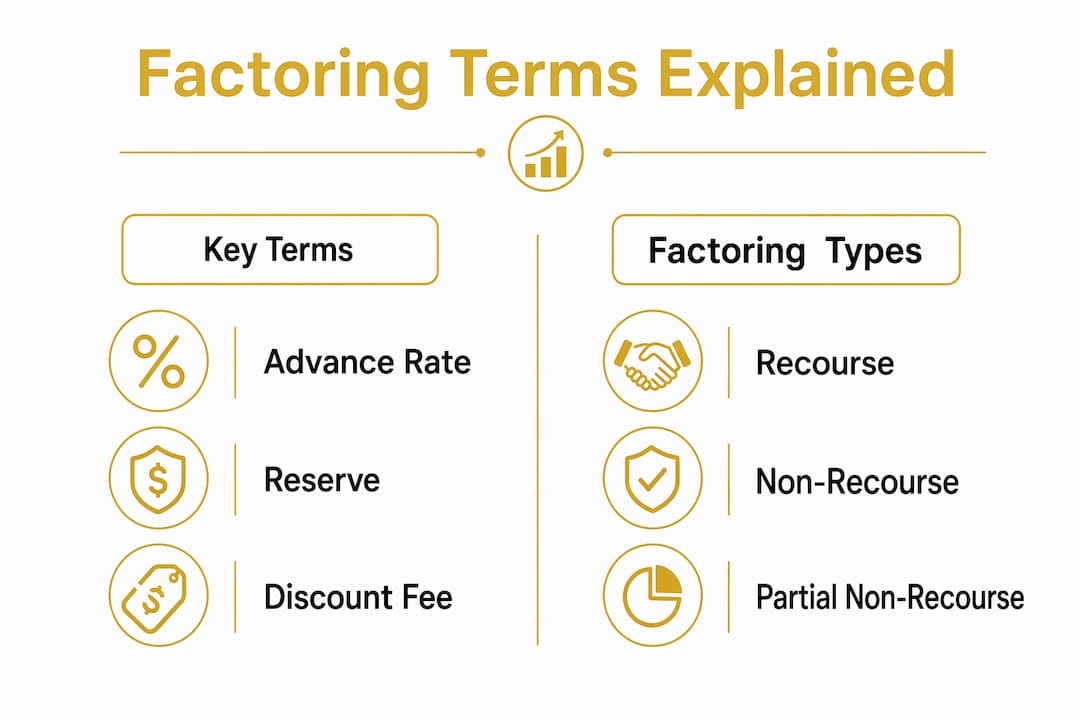
Recourse vs. non-recourse: With recourse factoring, you buy back any invoice your customer doesn’t pay. With non-recourse, the factor absorbs the credit loss — but only for specific, defined events (usually outright customer insolvency, not slow payment or disputes). Most “non-recourse” contracts have narrower protections than business owners expect.
Tiered/time-based pricing: Many factors charge a base rate for the first 30 days, then add a smaller percentage for each additional aging tier. Aging charges compound when customers pay late, which is where costs quietly climb.
Quick example: A 2% monthly fee on a $20,000 invoice costs $400 at 30 days. If the customer pays at 60 days, you owe $800 total — not $400.
Pro Tip: Always ask whether the fee is charged on the invoice face value or on the amount advanced. Fees on face value are more expensive than they look — compute “per-dollar cost” as total fees divided by cash advanced for a true comparison.
What are typical U.S. invoice factoring rates and advance percentages?
The table below shows the benchmark ranges you’ll encounter when shopping for factoring in 2026. Use it to quickly judge whether a quote is competitive or overpriced.
The typical factoring fees and advance rates vary depending on invoice terms and program type. Generally, earlier invoice terms yield lower fees and higher advances, while longer terms and non-recourse programs tend to cost more and advance less. Most providers charge between 1%–5% per 30-day period, and market averages cluster near 2.5% per month. Advance rates usually fall between 70% and 90% of invoice face value. Cleanest deals tend to be priced at the lower end of published ranges.
Net 30 invoices to creditworthy customers are the cheapest to factor
Non-recourse programs cost 1–2 percentage points more per period than recourse
Advance rates drop as invoice terms lengthen, because the factor carries risk longer
Annualized, a 2.5% monthly fee equals roughly 30% APR — factor that into any cost comparison
What factors drive your specific invoice factoring rate?
Factors don’t price every deal the same way. Here’s what moves the needle most, ranked by impact.

1. Debtor (customer) creditworthiness. This is the single biggest driver. Factors underwrite primarily on your customer’s credit profile, not yours. Invoices billed to large, stable, or publicly traded companies get the best pricing. A $50,000 invoice to a Fortune 500 buyer will price better than the same invoice to a small regional contractor.
2. Invoice age and payment terms. Net 30 invoices are cheapest. Every 30 days of additional terms adds cost because the factor holds risk longer. Late-paying customers compound this through aging tiers.
3. Monthly volume and invoice size. Higher, consistent monthly volume and larger invoice sizes typically secure lower percentage pricing. Fixed per-invoice processing costs get spread across more dollars, so factors can afford to trim the rate.
4. Industry risk. Construction, staffing, and healthcare factoring often carry higher rates than freight or manufacturing because of dispute rates, lien complexity, or slow payment norms in those sectors.
5. Concentration risk. If 80% of your receivables come from one customer, a factor’s entire exposure is tied to that single debtor. Concentration risk can trigger higher rates or lower advance limits — some factors impose concentration caps as a result.
6. Recourse vs. non-recourse structure. Recourse programs are cheaper because you absorb default risk. Non-recourse adds 1–2 percentage points to cover the factor’s credit exposure.
7. Contract structure and minimums. Committing to a minimum monthly volume or a longer contract term often unlocks better pricing. The trade-off is reduced flexibility.
Pro Tip: Bundle your cleanest, largest invoices to creditworthy customers into your initial factoring application. Demonstrating volume and debtor quality upfront gives you leverage to negotiate a lower rate before you’re locked into a contract.
Hidden and add-on fees that change your all-in cost
The headline discount rate is only part of what you’ll pay. These additional charges are common and can add 0.5–1.0 percentage points or more to the effective cost of a factoring program.
Application/origination fee: A one-time setup charge, sometimes waived for larger programs
Due diligence fee: Covers credit checks on your customers, varying based on provider and debtor volume
ACH/wire transfer fee: Charged per funding event
Monthly minimum fee: Charged if monthly factored volume is below a threshold
Lockbox/servicing fee: Covers collections management and payment processing
Early termination penalty: May apply if contract ends early, potentially equaling multiple months of fees
Audit fee: Some contracts require periodic field audits with associated fees
Watch out for tiered aging penalties. A contract that charges 2% for the first 30 days and then 0.— for every additional 10-day period can more than double your cost on a slow-paying invoice. Read the aging schedule in full before signing.
Minimum monthly volume clauses deserve special attention. Many factoring contracts contain automatic-renewal, minimum monthly volume, or early termination penalties that create effective lock-in. A lower headline rate with a punishing minimum can cost more than a slightly higher rate with no minimum.
Recourse vs. non-recourse factoring: what the cost difference actually means
The choice between recourse and non-recourse factoring is really a question of who pays when a customer doesn’t.
Feature | Recourse factoring | Non-recourse factoring |
Typical fee range | 1%–3% per 30 days | 3%–5% per 30 days |
Who absorbs credit default | You (the seller) | Factor (for qualifying events) |
Advance rate | 80%–90% | Around 85% (sometimes lower on riskier invoices) |
Collections handling | Often managed by factor | Factor manages; narrower dispute coverage |
Best for | Creditworthy customers, cost-sensitive sellers | Sellers with genuine credit-risk concerns |
Recourse is cheaper (1%–3% per 30 days) because you bear the default risk; non-recourse runs 3%–5% because the factor absorbs it. The catch: most non-recourse contracts define “default” narrowly. Slow payment, disputes, and short pays are almost always excluded. You’re typically only protected against outright customer insolvency.
“Partial non-recourse” programs exist in the middle — the factor covers insolvency but you cover disputes and slow pays. Read the definition of default events carefully, and check the cure period (how long a customer can be late before the recourse obligation triggers).
Pro Tip: If your customers are large, creditworthy companies with a strong payment history, recourse factoring is almost always the better deal. You’re paying a 1–2 percentage point premium for non-recourse protection you’re unlikely to need.
Three worked examples showing net proceeds and total cost
These are hypothetical examples with explicit assumptions — use them as a calculation template for your own invoices.
Example A | Example B | Example C | |
Invoice amount | $10,000 | $50,000 | — |
Advance rate | 85% | 80% | — |
Fee structure | 2% flat/30 days | 2.5% flat/30 days | 1.5% first 30 days + 0.5%/10 days |
Customer pays at | Day 30 | Day 60 | Day 45 |
Cash advanced | $8,500 | $40,000 | — |
Total fee | $200 | $2,500 | $500 |
Reserve released | — | $7,500 | — |
Net proceeds | $9,800 | $47,500 | — |
Effective APR (approx.) | ~24% | ~30% | — |
Example A breakdown: You receive $8,500 upfront on a $10,000 invoice. The factor charges 2% on the full $10,000 face value ($200), not on the $8,500 advanced. At day 30, your customer pays, the factor releases the $1,500 reserve minus the $200 fee, and you net $9,800 total. A 2% monthly fee annualizes to roughly 24%.
Example B breakdown: At 60 days, two full 30-day periods apply. The 2.5% fee runs twice on the $50,000 face value, totaling $2,500. You received $40,000 upfront and recover $7,500 of the reserve at payoff. Net proceeds: $47,500 on a $50,000 invoice.
Example C breakdown: Tiered pricing charges 1.5% for the first 30 days ($375) plus 0.5% for the next 15 days (1.5 tiers of 10 days = $125), totaling $500. Compare that to a flat 2% program: $500 flat fee. In this case they’re equal — but if the customer paid at day 60, the tiered program would cost $625 vs. $1,000 flat. Tiered pricing rewards fast-paying customers.
Fees are always on face value, not the advance — a critical distinction
Longer payment cycles compound cost quickly under flat-rate programs
Tiered pricing can be cheaper when customers pay promptly
Is invoice factoring worth it for your business?
Factoring is a tool, not a universal solution. Here’s when it makes sense and when another product likely costs less.
Pros:
Immediate liquidity without waiting 30–90 days for customer payment
Approval based primarily on your customers’ credit, not your balance sheet
Funds in 24–48 hours after initial setup
No bank-style covenants or collateral requirements beyond the receivables themselves
Cons:
Effective APR is high — typically around 24%–30% annualized at market-average rates, though it can reach 60%+ depending on terms and invoice aging
Customers may be contacted by the factor, which some perceive as a sign of financial stress
Contract lock-in, minimums, and termination penalties can trap you at a higher cost
Extra fees (wire, audit, due diligence) add up across a full year
Decision checklist:
Short-term cash crunch with creditworthy customers: Factoring is likely the right tool. You get fast cash and the cost is justified by the liquidity.
Predictable seasonal working capital needs: A business line of credit is almost always cheaper and more flexible for recurring needs.
High customer concentration or frequent disputes: Factor only with carefully negotiated contract terms — concentration risk raises your rate and dispute exclusions in non-recourse contracts can leave you exposed.
Long-term, ongoing working capital: Consider a term loan or revolving line of credit. The annualized cost of factoring every invoice indefinitely is hard to justify against a 7%–12% term loan.
Startup with no credit history: Factoring can work here because underwriting focuses on your customers, not you — but watch the fee structure carefully.
How to compare factoring offers and the exact questions to ask
Most business owners compare factoring quotes by looking at the headline discount rate. That’s the wrong move. Here’s a better framework.
Normalize to per-dollar cost: Divide total fees (including all add-ons) by the cash advanced. A 2% fee on a $10,000 invoice where you received $8,500 means you paid $200 for $8,500 — a per-dollar cost of 2.35%, not 2%. This is the only fair way to compare quotes with different advance rates and fee structures. Fees are charged on face value, not the advance, so the headline rate always understates the true cost.
Convert to effective APR using the invoice aging period. Multiply the per-period rate by the number of periods in a year. A 2.5% monthly rate = 30% APR. Use a loan cost calculator to cross-check your math on different aging scenarios.
Ten questions to bring to any factor or broker meeting:
What is your discount fee, and is it charged on face value or the advance?
What advance rate do you offer for my specific customer base?
How does your aging tier work after 30 days?
What are all the fees beyond the discount rate (wire, due diligence, audit, monthly minimum)?
Is this a recourse or non-recourse program, and how do you define a qualifying default event?
What is the contract term, and what is the early termination penalty?
Is there an automatic renewal clause?
Do you contact my customers directly, and can collections be white-labeled?
What is the typical funding timeline after I submit an invoice?
Can you provide a sample contract or statement of work before I commit?
A transparent factor answers all ten without hesitation. Vague answers on aging tiers, termination fees, or the definition of non-recourse default are red flags.
How Cotifunding helps you get better factoring rates by comparing options
Cotifunding is a financing brokerage, not a direct lender. That distinction matters when you’re shopping for factoring because no single factor offers the best rate for every business type, customer base, or invoice volume.
Here’s what working with a brokerage actually does for you:
Compares multiple independent factoring providers simultaneously, so you see competing offers without making a dozen separate calls
Negotiates terms on your behalf, including aging tier structures, advance rates, and minimum volume requirements
Advises on white-label or soft-notification collection options to protect customer relationships
Helps you prepare the documentation that gets you the best pricing upfront
What to bring to a broker meeting:
Average invoice age and payment terms for your top customers
List of your top 10 customers with approximate annual invoice volume
Monthly invoice volume (last 3–6 months)
Sample invoices and any existing factoring contracts
Desired funding cadence (weekly, bi-weekly, as-needed)
The invoice factoring blueprint Cotifunding publishes walks through exactly how to prepare this documentation and what factors look for in an initial submission.
Pro Tip: Bring your aging report to the first broker meeting. Factors price risk on how quickly your customers actually pay, not just the stated invoice terms. A clean aging report with consistent 30-day payment history is one of the strongest negotiating tools you have.
Disclosure: Cotifunding connects businesses with independent funding providers and does not directly lend, underwrite, or guarantee specific rates or approvals.
Key Takeaways
Invoice factoring rates in the U.S. run 1%–5% per 30-day period, but the advance rate, hidden fees, and contract terms determine what you actually pay — always normalize quotes to per-dollar cost before deciding.
Point | Details |
Typical rate range | Factoring fees run 1%–5% per 30-day period; the market average clusters near 2.5% per month. |
Advance rate norms | Expect 70%–90% of invoice face value upfront; Net 30 invoices to strong debtors get the best advances. |
Fees are on face value | A 2.5% fee on a $50,000 invoice costs $1,250 even if you only received $40,000 — compute per-dollar cost to compare fairly. |
Hidden fees add up | Add-on fees (wire, due diligence, minimums, termination) can add 0.5–1.0 percentage points or more to the headline rate. |
Cotifunding brokerage | Cotifunding compares multiple independent factoring providers so you see competing offers without contacting each lender separately. |
Why the “cheapest rate” is almost never the right question
Most business owners walk into a factoring conversation focused on one number: the discount rate. After years of watching SMBs navigate financing decisions, the pattern that causes the most expensive mistakes isn’t choosing the wrong rate — it’s signing a contract without reading the aging tier schedule, the minimum monthly volume clause, or the termination penalty.
A 1.5% monthly rate sounds like a win until you’re six months into a 12-month contract with a $50,000 monthly minimum you can’t hit, paying a shortfall fee every single month. Meanwhile, a 2.5% rate with no minimum and a 30-day exit clause would have cost less in total.
The other mistake: treating non-recourse factoring as credit insurance. It isn’t. Most non-recourse contracts protect you only against outright customer bankruptcy — not slow payment, not disputes, not short pays. Business owners who discover this after a customer dispute are usually surprised and frustrated.
The right question isn’t “what’s the lowest rate?” It’s “what’s the total cost under my actual invoice aging scenario, and what does this contract cost me if I need to leave?” Run the math on your real numbers, not the best-case scenario the factor presents.
Compare factoring offers through Cotifunding before you commit
Signing the first factoring offer you receive is one of the most expensive habits in small business finance. Rates, advance percentages, aging tiers, and contract terms vary significantly across independent providers — and the difference between a well-negotiated deal and a default offer can run into thousands of dollars per year.
Cotifunding works with independent factoring providers across the U.S. and helps small businesses compare real offers side by side — without the pressure of dealing with each provider separately. The process starts with a soft credit pull, so pre-qualifying won’t affect your credit score. Most clients receive initial quotes within 24 hours of submitting their invoice and customer data.
Ready to see what your invoices are actually worth? Get your factoring options through Cotifunding and compare offers before you sign.
Cotifunding is a financing brokerage that connects businesses with independent funding providers. It does not directly lend, underwrite, or guarantee specific rates, approvals, or funding outcomes.
Useful sources and tools for further research
These resources let you run your own numbers, validate a quote, and go deeper on factoring mechanics before you meet with a broker.
Corpay: Invoice Factoring Guide — Covers how factoring works, what it costs, and when it’s the wrong choice. Good for understanding the full fee picture and when to walk away.
InvoPilot Factoring Calculator — Free calculator for modeling advance amounts, fees, and effective APR across different invoice aging scenarios. Run your actual invoices through it before any broker meeting.
TheMCAguide: Accounts Receivable Factoring — Detailed breakdown of recourse vs. non-recourse pricing, contract risks, and volume-based rate drivers.
FreightWaves: Cost of Factoring — Explains tiered and time-based pricing structures in plain language; especially useful for freight and logistics businesses.
AmcomCap: How Your Rate Is Determined — A practitioner’s view of how factors actually price deals, including real-world average discount rates from an active provider’s client book.
This article is general information, not financial or legal advice. Confirm current rates, contract terms, and eligibility with a qualified professional or licensed provider before making financing decisions.
Recommended
Disclosure: Coti Funding is not a direct lender. We connect businesses with independent third-party lenders and financing providers. Financing products, rates, terms, funding amounts, approval requirements, and funding timelines vary by provider and applicant qualifications and are not guaranteed. Any rates, terms, examples, or scenarios presented in this article are for general informational and educational purposes only and may not reflect actual offers available to a particular business. Submission of information or an application does not guarantee approval or funding. This content does not constitute financial, legal, tax, or investment advice.
Comments