Invoice Factoring for Startups: Get Funded Fast in 2026

Updated: Jul 26

Yes, your startup can use invoice factoring today. The one condition: you invoice other businesses or government agencies, and those customers have decent credit. If that describes you, here are three things to do right now.
Check invoice eligibility. Your invoices must be for delivered goods or completed services billed to B2B or B2G customers. Consumer-facing invoices do not qualify.
Gather three documents. Pull your most recent accounts receivable aging report, copies of outstanding invoices, and your business formation documents (Articles of Organization or Incorporation).
Run a soft prequalification. Cotifunding uses a soft credit pull, so checking your options costs you nothing and won’t affect your credit score. Start your prequalification in minutes.
Pro Tip: Factoring approval hinges on your customers’ credit, not yours. If you invoice Fortune 500 companies or established government agencies, your odds of approval are strong even if your startup is six months old.
Table of Contents
What types of factoring programs and contract terms should startups know?
What does factoring actually cost? Realistic U.S. startup examples
Who qualifies? Startup eligibility rules and required documents
Factoring vs. loans, lines of credit, or equity: which one fits your startup?
How do you choose a factoring partner? 8 criteria and exact questions to ask
What does the factoring application process look like, and how long does it take?
A Cotifunding startup case study: from prequalification to same-day funding
How does invoice factoring actually work for startups?
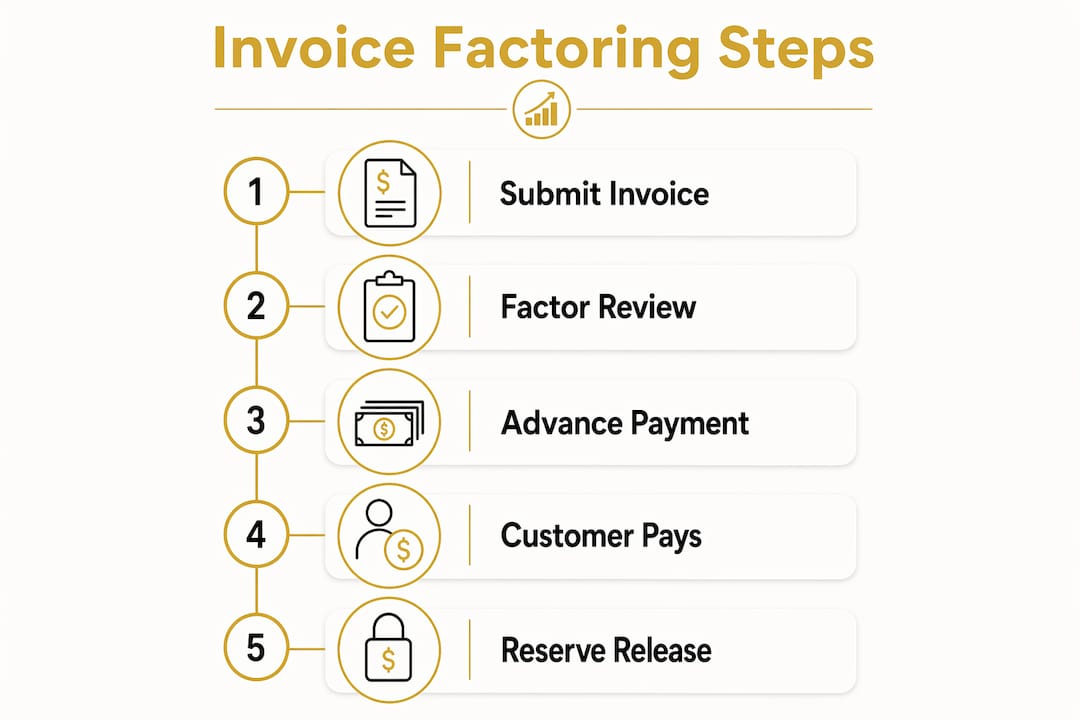
The mechanics are simpler than most founders expect. You deliver a service or product, send an invoice to your business customer, then sell that invoice to a factoring company instead of waiting 30, 60, or 90 days to get paid. The factor advances you a large portion of the invoice value immediately, then collects directly from your customer when the invoice comes due. Once the customer pays, the factor releases the remaining balance to you, minus their fee.
Here is the step-by-step flow:
You issue an invoice to your B2B or B2G customer.
You submit that invoice to the factoring company.
The factor advances a large portion of the invoice value to you, usually within 24 hours.
The factor contacts your customer and collects payment on the due date.
The factor releases the remaining balance (the “reserve” or “holdback”) to you, minus their fee.
Core terms every founder needs:
Advance rate: The percentage of the invoice the factor pays you upfront. Typically 80%–95%.
Reserve (holdback): The portion held back until the customer pays. Usually 5%–20%.
Discount/factor fee: The cost of the service, typically 1%–5% of the invoice value, depending on how long the invoice is outstanding and your customer’s credit profile.
Recourse factoring: If your customer doesn’t pay, you’re responsible for buying the invoice back. Lower fees, more risk on your side.
Non-recourse factoring: The factor absorbs the loss if your customer defaults due to insolvency. Higher fees, less risk for you.
The most important thing to understand about underwriting: factors evaluate your customers’ credit, not your startup’s age or profitability. A six-month-old company invoicing a major hospital network or a government agency is a far easier approval than a five-year-old company invoicing dozens of small, unknown clients.
Pro Tip: Consolidate your factoring submissions around your most creditworthy customers first. Clean, undisputed invoices with established corporate or government debtors get the best advance rates and the fastest approvals.

What types of factoring programs and contract terms should startups know?
Not all factoring arrangements are built the same, and the wrong contract can cost you more than the fee itself.
Recourse vs. non-recourse factoring
With recourse factoring, you guarantee the invoice. If your customer doesn’t pay, you buy it back or the factor deducts it from future advances. Fees are lower, typically on the lower end of the 1%–5% range. Most startup-friendly factors offer recourse arrangements because they carry less risk for the factor.
Non-recourse factoring shifts the credit-default risk to the factor, but only for specific reasons (usually customer insolvency, not slow payment or disputes). Fees are higher. Read the fine print carefully: many “non-recourse” contracts only cover bankruptcy, not simple non-payment.
Spot factoring vs. factoring lines
Spot factoring (also called single-invoice factoring) lets you sell one invoice at a time with no ongoing commitment. It’s more expensive per invoice but gives you maximum flexibility. Good for startups testing the waters or with occasional large invoices.
A factoring line (master agreement) is an ongoing arrangement where you submit invoices regularly. Fees are usually lower, volume discounts apply, and the relationship deepens over time. Better for startups with predictable, recurring B2B billing.
Contract terms checklist
Before signing anything, verify these:
Monthly minimums: Some factors require you to factor a minimum dollar amount each month. Missing it triggers fees.
Termination clauses: Look for notice periods (30, 60, 90 days) and early-exit penalties.
Customer notification policy: Most factors notify your customers that invoices have been assigned. Confirm the language they use so you can prepare your clients.
Fee add-ons: Watch for wire fees, ACH fees, due diligence fees, and monthly maintenance charges that inflate the effective cost beyond the stated rate.
Feature | Recourse Factoring | Non-Recourse Factoring | Spot Factoring | Factoring Line |
Who bears default risk | Startup | Factor (insolvency only) | Startup (usually) | Varies by agreement |
Typical fee range | Lower end of 1%–5% | Higher end of 1%–5% | Higher per invoice | Lower with volume |
Commitment required | Yes (ongoing) | Yes (ongoing) | No | Yes |
Best for | Predictable billing | High-risk debtors | Occasional large invoices | Regular B2B billing |
What does factoring actually cost? Realistic U.S. startup examples
Advance rates are generally high and factoring fees typically range from low to moderate percentages per invoice. Where you land depends on your customer’s credit, invoice size, days outstanding, and the factor’s volume thresholds.
Sample invoice math
Scenario | Invoice Amount | Advance Rate | Advance Received | Factor Fee | Reserve Released | Total Received |
Strong customer, 30-day terms | $50,000 | 90% | $45,000 | 2% ($1,000) | $4,000 | $49,000 |
Average customer, 60-day terms | $50,000 | 80%–95% | $40,000–$47,500 | 1%–5% ($500–$2,500) | $2,500–$9,000 | $42,500–$47,000 |
Weaker customer, 90-day terms | $50,000 | 80% | $40,000 | 5% ($2,500) | $7,500 | $47,500 |
The 30-day scenario costs you $1,000 on a $50,000 invoice. The 90-day scenario costs $2,500. That difference reflects the factor’s added risk and carrying time, not arbitrary pricing.
How factoring fees compare to loans
A 2% fee on a 30-day invoice translates to roughly 24% annualized. That sounds high until you compare it to a merchant cash advance, which can run 40%–150% effective APR, or the cost of losing a contract because you couldn’t make payroll. As one finance guide notes, factoring reduces margins but can be cheaper than other short-term alternatives when you factor in opportunity cost.
Pro Tip: To compare quotes from different factors on equal footing, use this formula: (Fee ÷ Invoice Amount) ÷ Days Outstanding × 365 = Effective Annual Rate. A 2% fee on a 30-day invoice = (0.02 ÷ 1) ÷ 30 × 365 = ~24.3% APR. Run this on every quote you receive.
The real question isn’t whether 2% is expensive in isolation. It’s whether the cash you get today enables growth that more than covers that cost. Factoring fees reframed as growth investment rather than pure expense changes the math entirely for a startup chasing a contract it couldn’t otherwise fulfill.
Who qualifies? Startup eligibility rules and required documents
Factoring approval is more accessible for startups than most founders realize, because the underwriting focuses on your customers’ credit history, not your business’s age or profitability.
Eligibility checklist
Your business invoices other businesses or government entities (B2B or B2G).
Invoices are for goods already delivered or services already completed (no pre-billing).
Your customers have verifiable credit histories and are not in financial distress.
Your accounts receivable are free of prior liens (no UCC filings by a bank or the IRS that claim your receivables).
You do not have heavy concentration in one customer without that customer being creditworthy.
Documents to prepare before applying
Accounts receivable aging report (current, showing all open invoices by customer and days outstanding)
Copies of outstanding invoices you want to factor
Corresponding customer contracts or purchase orders
Articles of Organization or Incorporation
Recent business bank statements (typically 3 months)
Government-issued ID for the business owner(s)
Common red flags and how to clear them
Consumer invoices: Factoring requires B2B or B2G receivables. If you sell to individual consumers, factoring is not available to you regardless of invoice size.
UCC liens on receivables: If a bank or the IRS holds a lien on your accounts receivable, the factor cannot take a first-position security interest. You’ll need to get the lien released or have the existing lienholder sign a subordination agreement. Reputable factors will often walk you through this process.
Heavy customer concentration: If 80% of your receivables come from one customer, most factors get nervous. The fix is diversifying your customer base over time, or finding a factor that specializes in your industry and is comfortable with concentration risk.
Disputed or pre-billed invoices: Factors only purchase clean, undisputed invoices for work already performed. Resolve any billing disputes before submitting.
What are the real pros and cons of factoring for startups?
Practical advantages
No debt added to your balance sheet. You’re selling an asset (the invoice), not borrowing money.
No equity dilution. You keep full ownership and control of your company.
Approval based on customer credit. A new startup with strong corporate clients can qualify where a bank would say no.
Faster growth. Converting invoices to cash quickly lets you accept larger contracts and offer competitive payment terms to customers.
Outsourced collections. The factor handles chasing payment, freeing your team for revenue-generating work.
Better supplier terms. Paying suppliers faster often unlocks early-payment discounts.
Real drawbacks
Fee reduces your margin. On thin-margin contracts, a 3%–5% fee can be painful.
Customer notification. Most factors notify your customers that invoices have been assigned. Some clients react poorly to this.
Contract lock-in. Factoring lines often come with minimum volume commitments and termination notice periods.
Not suitable for B2C. Consumer-facing businesses are generally ineligible because factors can’t efficiently evaluate or collect from individual retail consumers.
Where factoring tends to work well for startups
Factoring fits best in industries with long payment cycles and established business customers: staffing agencies, manufacturers, IT services, transportation, and commercial cleaning are all natural fits. A staffing startup that pays employees weekly but gets paid by clients in 45 days is the textbook use case.
Where it doesn’t fit: B2C e-commerce, retail, or any business with margins so thin that a 2%–5% fee wipes out profit entirely.
Managing customer relationships when a factor collects
Be transparent with your customers before the factor contacts them. A brief email explaining that you’ve partnered with a funding company to manage receivables, and that payment instructions will come from that company, prevents confusion and preserves trust. Most established businesses have seen this arrangement before.

Factoring vs. loans, lines of credit, or equity: which one fits your startup?
No single instrument is right for every stage. Here’s how they stack up on the criteria that matter most to early-stage founders.
Factoring vs. term loans
Factoring: no fixed monthly payment, approval based on customer credit, funded in 24–48 hours after setup.
Term loans: fixed repayment schedule, requires business history and credit, takes weeks to close.
Choose factoring when you need cash now and have invoices to sell. Choose a term loan when you need a lump sum for equipment or expansion and can wait.
Factoring vs. lines of credit
Factoring: self-liquidating (the invoice pays it off), no revolving balance to manage.
Business lines of credit: flexible draws, lower cost per dollar, but requires established credit and often a personal guarantee.
Many startups use both: a line of credit for operational flexibility, factoring for large invoice-specific cash needs.
Factoring vs. equity
Factoring: no dilution, no board seats, no investor approval needed for decisions.
Equity: no repayment obligation, but you give up ownership and often control.
If your growth is driven by receivables (not product development), factoring preserves equity for rounds where you actually need it.
Decision checklist: which instrument fits your situation?
Need cash in under 48 hours? Factoring or a merchant cash advance.
Have B2B invoices outstanding? Factoring is likely your fastest path.
Want to avoid any debt or repayment obligation? Factoring (asset sale, not a loan).
Have strong personal/business credit and time to wait? A line of credit is cheaper long-term.
Need capital for product development or hiring without revenue? Equity or startup-specific funding programs.
Concerned about dilution? Factoring, lines of credit, or startup funding options that don’t require equity.
Mixing instruments is often the smartest play. A startup that factors its largest invoices while maintaining a small line of credit for payroll gaps has two tools working in parallel, each doing what it does best.
How do you choose a factoring partner? 8 criteria and exact questions to ask
Choosing the wrong factor costs more than the fee. Here are eight criteria to evaluate, plus the exact questions to ask on a discovery call.
Eight selection criteria
Advance rate: What percentage of the invoice do they advance upfront? Anything below 80% deserves scrutiny.
Fee structure: Is the fee flat or tiered by days outstanding? Get the full fee schedule in writing.
Recourse terms: Under what conditions are you required to buy back an invoice? Get the exact language.
Customer notification policy: What do they say to your customers, and how? Ask to see the notification letter.
Contract length and minimums: What is the minimum monthly volume? What is the notice period to exit?
Funding speed: How quickly do they fund after invoice submission? After initial setup?
Industry expertise: Do they have experience in your sector? Industry-specific factors often have better advance rates and fewer surprises.
Onboarding support: Do they assign a dedicated contact? How do they handle the first submission?
Questions to ask on the call (use these verbatim)
“What is your advance rate for invoices in my industry, and what drives it up or down?”
“Walk me through your complete fee schedule, including any wire, ACH, or maintenance fees.”
“What does your customer notification letter say, and can I see a sample?”
“What are the exact conditions under which I’d have to buy back an invoice?”
“What is the minimum monthly volume, and what happens if I miss it?”
“How long does initial setup take, and how quickly do you fund after I submit an invoice?”
Red flags to watch for
Vague answers about fees (“it depends” without specifics)
Pressure to sign before you’ve seen the full contract
No sample notification letter available
Termination clauses requiring 90+ days notice with penalties
Factors who can’t name a single client in your industry
Compact comparison checklist (copy into a spreadsheet)
What does the factoring application process look like, and how long does it take?
Setup is faster than most founders expect. Factoring companies frequently fund invoices within 24 hours after setup, with onboarding typically completed in 1–3 business days.
Step-by-step application process
Step 1: Outreach and soft prequalification. Contact the factor, share basic business info, and run a soft credit check. This takes hours, not days.
Step 2: Document submission. Submit your aging report, sample invoices, customer contracts, Articles of Organization, and bank statements.
Step 3: Underwriting. The factor reviews your customers’ credit profiles and verifies invoice legitimacy. For clean invoices with creditworthy customers, this moves quickly.
Step 4: Agreement signing. Review and sign the factoring agreement. Read the termination clause and minimum volume requirements before signing.
Step 5: First invoice submission. Submit your first invoice. The factor verifies it with your customer (called a “notice of assignment”).
Step 6: Funding. Advance hits your account, typically within 24 hours of verified invoice submission.
Realistic timeline
Stage | Typical Duration | What Can Slow It Down |
Soft prequalification | Same day (hours) | Missing basic business info |
Document review and underwriting | 1–3 business days | UCC liens, disputed invoices, unknown customers |
Agreement signing and setup | Same day or next day | Contract negotiation, legal review |
First invoice funding | 24–48 hours after setup | Customer verification delays |
Subsequent invoice funding | 24 hours | Invoice disputes or customer credit issues |
Pro Tip: The single fastest way to shorten underwriting is to submit a clean aging report with customer contact information already filled in. Factors spend most of their time tracking down customer details. Hand it to them upfront and you can shave a full business day off the process.
A Cotifunding startup Hypothetical Example: from prequalification to same-day funding
A B2B services startup in the IT consulting space had landed its first enterprise client, a contract worth $120,000 over 90 days. The problem: the client’s payment terms were net-60, and the startup needed to cover contractor payroll within two weeks. A bank line of credit wasn’t an option at six months old with no established credit history.
The founder contacted Cotifunding and ran a soft prequalification the same afternoon. Because the enterprise client had strong credit, underwriting moved fast. The founder submitted the aging report, the signed contract, and the first $40,000 invoice. Cotifunding completed setup within two business days and funded the advance the following morning.
What made the process work:
Soft credit pull at prequalification meant no impact on the founder’s personal credit.
Cotifunding evaluated the enterprise client’s credit, not the startup’s six-month history.
Clean, signed contract and a single undisputed invoice meant underwriting had nothing to chase down.
Funding arrived within 24 hours of invoice verification.
The founder retained full equity and took on no debt.
Key Takeaways
Invoice factoring is a practical, non-dilutive cash flow tool for U.S. startups that invoice creditworthy B2B or B2G customers, with advances typically covering 80%–95% of each invoice, and fees generally ranging from 1% to 5% per invoice.
Point | Details |
Startups can qualify | Approval is based on customer credit, not startup age or profitability. |
Advance rates and fees | Factors generally advance 80%–95% upfront; fees typically range from 1% to 5% per invoice depending on days outstanding. |
Speed of funding | Setup takes 1–3 business days; subsequent invoices fund within 24 hours after setup. |
Key eligibility condition | Invoices must be B2B or B2G, for completed work, with no UCC liens on receivables. |
Cotifunding’s advantage | Cotifunding offers a soft credit pull prequalification, startup-friendly underwriting, and potential same-day funding for qualifying invoices. |
What founders usually get wrong about invoice factoring
Most founders who dismiss factoring have never actually looked at the numbers. They hear “sells your invoices” and picture a desperate, last-resort move for companies circling the drain. That framing is wrong, and it costs founders real money.
The businesses that use factoring most aggressively are often the fastest-growing ones. A staffing company that can fund payroll weekly while clients pay in 45 days isn’t struggling. It’s scaling. The fee is the cost of operating at a pace the business’s cash cycle can’t naturally support yet.
The second misconception is that factoring is always expensive. Compared to what? A 2% fee on a 30-day invoice is roughly 24% annualized. A merchant cash advance on the same cash need might run three times that. And the opportunity cost of turning down a $200,000 contract because you can’t make payroll is infinite. The fee looks different when you put it next to the alternative.
The third mistake is the customer relationship fear. Founders imagine their clients will be offended or alarmed when a factor contacts them. In practice, most established businesses have seen invoice assignment before. The key is a brief, professional heads-up from you before the factor reaches out. One email, two sentences, and the issue disappears.
What actually matters when evaluating factoring is this: does the cash you receive today enable revenue that more than covers the fee? If yes, the math works. If your margins are too thin to absorb even a 1% fee, factoring isn’t the problem. The margin is.
Cotifunding makes invoice factoring accessible for startups
Most startups don’t fail because they lack revenue. They stall because the cash from that revenue arrives too late to fund the next move. Cotifunding is built specifically for that gap.
The prequalification starts with a soft credit pull, so checking your options costs you nothing and leaves your credit score untouched. Cotifunding evaluates your customers’ credit, not your startup’s age, which means a six-month-old company with solid B2B clients can qualify where a bank would pass. Once set up, invoices can fund within 24 hours. No equity given up. No fixed monthly repayment. No months-long application process.
What founders get with Cotifunding:
Soft credit pull prequalification with no credit score impact
Startup-friendly underwriting focused on customer creditworthiness
Advance rates and transparent fee structures with no hidden add-ons
Potential same-day funding for qualifying invoices after setup
A dedicated contact who knows the factoring process and can move fast
If you have outstanding B2B invoices and need working capital now, prequalify with Cotifunding today and find out what you qualify for.
Useful sources and where to learn more
These sources back the claims in this article and give founders a starting point for deeper research.
American Commercial Capital: Can My Startup Use Invoice Factoring? — Covers startup eligibility, underwriting focus on customer credit, and industry fit. Use this to verify eligibility criteria and understand how factors evaluate new businesses.
Bankrate: What Is Invoice Factoring and How Does It Work? — Independent finance guide covering fee structures, effective cost comparisons, and margin impact. Use this for pricing benchmarks and APR comparisons.
Elite Funders: Invoice Factoring and Accounts Receivable — Covers advance rates, fee ranges, minimum invoice sizes, and funding timelines. Use this to benchmark what a startup-friendly factor’s terms should look like.
Factoring Express: Invoice Factoring for Startups — Step-by-step process overview and startup-specific guidance. Use this to understand the application flow and what to expect at each stage.
Cotifunding Blog — Broader funding guides covering lines of credit, term loans, merchant cash advances, and startup funding programs. Use this to compare factoring against other instruments available to your business.
Recommended
Disclosure: Coti Funding is not a direct lender. We connect businesses with independent third-party lenders and financing providers. Financing products, rates, terms, funding amounts, approval requirements, and funding timelines vary by provider and applicant qualifications and are not guaranteed. Any rates, terms, examples, or scenarios presented in this article are for general informational and educational purposes only and may not reflect actual offers available to a particular business. Submission of information or an application does not guarantee approval or funding. This content does not constitute financial, legal, tax, or investment advice.
Comments